
Do you want to start an IPTV business? Well, if you want to start an internet TV business in 2026, you are entering one of the fastest-growing segments in digital entertainment. Internet Protocol Television has changed the way people consume content. Instead of paying for traditional cable or satellite TV, millions of users now prefer streaming live channels, movies, and sports events directly over the internet.
The global IPTV market is projected to grow from $189 billion in 2025 to over $221 billion in 2026, with a compound annual growth rate of 17.1%. This growth is being driven by cord-cutting behavior, the expansion of high-speed internet, and rising demand for on-demand content across multiple devices.
This guide will walk you through everything you need to know from understanding what an IPTV business actually is to setting up your infrastructure, getting the right licenses, and building a customer base that stays.
What Is an IPTV Business?
An IPTV business is a service that delivers television content to subscribers over the internet using Internet Protocol networks, rather than traditional cable or satellite signals. The business can take different forms; you can operate as a full IPTV service provider, an IPTV reseller, or a white-label streaming platform.
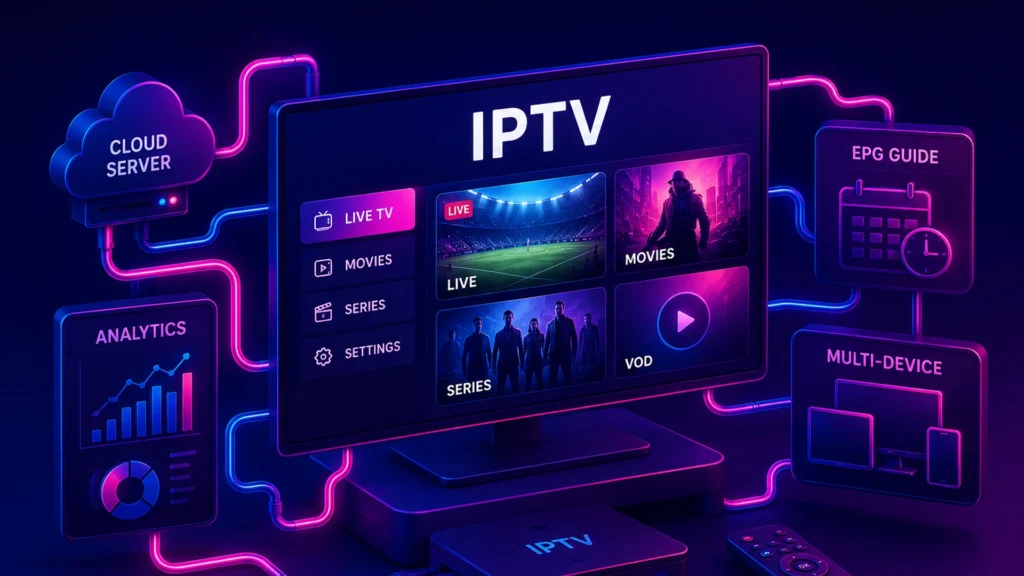
Large platforms like YouTube TV, Sling TV, Mom IPTV, and Hulu operate on this model at scale. But smaller, niche-focused IPTV services are also building sustainable businesses by serving specific audiences, sports fans, international communities, or regional language markets.
The core business flow looks like this: you acquire licensed content, encode and stream it through a server and content delivery network, and deliver it to subscribers through apps, smart TVs, set-top boxes, or web browsers. Revenue comes through subscriptions, pay-per-view events, or advertising.
Is an IPTV Business Legal?
Starting an IPTV business is legal, provided you operate within the boundaries of copyright law and hold the proper content licenses for the channels or media you distribute.
The legal issues in the IPTV industry arise when services distribute copyrighted content without authorization. If you source content from legitimate broadcasters and obtain proper licensing agreements, your business is fully compliant.
Before launching, consult a legal expert familiar with digital media law in your operating region. You will need to understand content licensing agreements, copyright and intellectual property laws, local broadcasting regulations, and business registration and taxation requirements.
Operating a legal IPTV business also builds long-term trust with your subscribers and protects you from shutdowns or penalties.
How Much Does It Cost to Start an IPTV Business?
The startup cost depends heavily on your business model. If you are launching as an IPTV reseller, entry costs can start at $200 or more, covering reseller panel access, basic marketing, and a website. If you are building your own IPTV streaming server from scratch, costs can run significantly higher due to server infrastructure, middleware software, CDN fees, and content licensing.
Here is a general breakdown:
Server or VPS hosting is $50 to $300 per month, depending on capacity. Content Delivery Network costs vary based on bandwidth usage. IPTV middleware platform: $100 to $500 per month for managed solutions. Content licensing varies widely by content type and geographic rights. Website, payment gateway, and marketing: $100 to $500 for initial setup.
Budgeting carefully at the start will prevent overspending before your subscriber base grows enough to cover operating costs.
Now, let’s check the step-by-step guidelines regarding the cost of IPTV business models:
Step 1: Market Research and Business Planning
Before spending a buck, spend time understanding the market. Realize who your target audience is, what content they want, and what they are currently paying for it. Look at competitor services in your niche and identify gaps in channels they do not carry, regions they do not serve, or pricing they do not offer.
A clear business plan should cover your target customer persona, your content strategy, your revenue model, your startup budget, and your six-month growth goals. This plan is not just paperwork; it is what keeps your decisions focused when things get complex.
If you are targeting a regional audience, research what languages and channels matter most to them. If you are focusing on sports, understand the rights cycle for the leagues you want to carry.
Step 2: Content Licensing and Legal Framework
Content licensing is the foundation of a legitimate IPTV business. Without proper rights, you cannot legally stream any channel, movie, or sporting event, regardless of where the content originates.
To get licensed content, you have two main paths. The first is to negotiate directly with broadcasters and content owners for streaming rights in your territory. The second is to work through an IPTV reseller program with a licensed provider, where they hold the content rights and you resell subscriptions under those rights.
Key legal areas to address include content licensing agreements, copyright compliance, digital rights management (DRM) implementation, and any local telecom or broadcasting regulations that apply to your country or region.
DRM technology is worth implementing early. It encrypts your video streams so that only authenticated subscribers can access your content, protecting your library from piracy.
Step 3: Setting Up Your IPTV Infrastructure
Your technical infrastructure is what determines the quality of your service. Poor infrastructure leads to buffering, downtime, and subscriber churn.
The three core components of IPTV infrastructure are:
Your streaming server or Virtual Private Server (VPS) is where your content is hosted and distributed. Choose a server with adequate processing power, RAM, and storage based on the number of simultaneous streams you expect to support.
Your encoding and transcoding software converts raw video into streamable formats. It also handles adaptive bitrate streaming, which automatically adjusts video quality based on a viewer’s internet connection speed.
Your Content Delivery Network (CDN) distributes your content across multiple servers geographically, reducing latency and ensuring smooth playback for subscribers in different locations. A reliable CDN is not optional for a serious IPTV service; it directly affects the viewer experience.
Step 4: Choosing IPTV Middleware
IPTV middleware is the software layer that connects your streaming server to your subscribers. It manages user authentication, subscription billing, channel access, electronic program guides (EPG), and multi-device support.
Good middleware allows subscribers to log in, see their channel lineup, access on-demand content, and manage their account, all without you managing each request manually. It also gives you an admin panel to monitor usage, manage subscriptions, and handle payments.
Popular middleware solutions include Xtream Codes API, Stalker Middleware, and various commercial platforms designed specifically for IPTV operators. Evaluate them based on the number of subscribers you plan to serve, device compatibility, and how much technical management you want to handle yourself.
Step 5: Building Your IPTV Platform and User Interface
The user interface of your IPTV service directly affects subscriber satisfaction and retention. A clean, responsive interface that works across smart TVs, Android devices, iOS, Firestick, MAG boxes, and web browsers is essential.
Most IPTV services are accessed through dedicated apps or IPTV player apps like TiviMate or IPTV Smarters. If you are building a branded experience, consider developing or white-labeling your own application so subscribers see your brand, not a generic interface.
Keep the interface intuitive. Subscribers should be able to browse channels, access their favorite content, and navigate the EPG without confusion. A confusing user experience drives cancellations.
Step 6: Pricing and Monetization Strategy
The most common IPTV monetization model is subscription-based (SVOD), where subscribers pay a recurring monthly or annual fee for access. This model provides predictable revenue and is what most IPTV services use.
Other models include Pay-Per-View (PPV) for live sports or special events, Advertising-Based Video on Demand (AVOD) where access is free but ad-supported, and hybrid models that combine subscriptions with PPV add-ons.
For pricing, study your target market. What is the average income level of your audience? What do competing services charge? A typical IPTV subscription ranges from $10 to $30 per month, with annual plans offered at a discount. Also, discount IPTV service provider(s) during various occasions such as Christmas, easter sunday, etc.
Further, offer a free trial when you launch. It reduces the friction for new subscribers to commit, and if your service quality is good, conversions will follow.
Step 7: Marketing Your IPTV Business
You can have the best content library and the most stable servers in the industry. But without subscribers finding your service, none of it matters.
Search engine optimization is the most sustainable long-term marketing channel for an IPTV business. Target keywords related to what your audience is searching for, including phrases around IPTV services, cord-cutting, live TV streaming, and specific channels or sports they want to watch. Publish useful content that answers real questions your potential subscribers have.
Social media marketing on platforms like Facebook, YouTube, and Reddit can drive early awareness. Demonstration videos showing your interface, channel count, and streaming quality are particularly effective.
Referral programs incentivize your existing subscribers to bring in new ones. Offering one month free for every successful referral is a low-cost acquisition strategy that compounds over time.
Running seasonal promotions and discounts around major sporting events, for example, converts price-sensitive prospects who have been considering your service.
Step 8: Customer Retention and Scaling
Acquiring a subscriber is only half the work. Keeping them is what builds a sustainable IPTV business.
Customer retention starts with reliability. If your streams buffer frequently or channels go down, subscribers will cancel and tell others. Monitor your uptime, fix issues quickly, and communicate with subscribers when there are disruptions.
Support quality matters. Offer responsive customer service through live chat or ticketing. Subscribers who get fast, helpful responses when they have problems are far less likely to churn.
Continually improve your content library. Add channels your subscribers request, improve stream quality as your infrastructure scales, and offer features like 4K streaming or multi-screen access as your business grows.
Track your data. Monitor which channels are most watched, what time of day usage peaks, and where subscribers are dropping off in their experience. These insights inform your content and platform decisions better than any guesswork.
Common Mistakes to Avoid When Starting an IPTV Business
- Operating without proper content licenses is the most serious mistake and can result in legal action and shutdowns. Never launch a service without confirming the legal standing of every content stream you offer.
- Underestimating infrastructure costs is another common issue. A server that works fine for 50 subscribers will collapse under 500. Plan your infrastructure to scale before you need it.
- Ignoring customer support leads to churn. A subscriber who cannot get help with a login issue or buffering problem will not renew.
- Copying a competitor’s channel list without verifying the rights to each channel exposes you to copyright liability even if you believe the content is freely available.
- Relying on a single payment method limits who can subscribe to your service. Accept credit cards, debit cards, PayPal, and digital wallets at a minimum.
Frequently Asked Questions About Starting an IPTV Business
Starting an IPTV business comes with a lot of questions. Below, we have answered the most common ones to help you move forward with clarity and confidence.
-
How can I start an IPTV business with no technical experience?
The simplest path is to start as an IPTV reseller through a licensed provider that already has the infrastructure in place. You purchase a reseller panel, set your own pricing, and manage your subscriber base without building servers or handling encoding yourself.
-
Is starting an IPTV business legal in 2026?
Yes, as long as you work with licensed content and comply with copyright law in your operating region. The legality depends entirely on whether the content you distribute is properly licensed, not on the technology itself.
-
How much does it cost to start an IPTV business?
Entry-level reseller setups can start from $200. Building your own streaming infrastructure with a VPS, CDN, middleware, and content licensing will typically cost $500 to several thousand dollars, depending on your scale.
-
Do I need a license to run an IPTV service?
Yes. You need proper licensing for any content you stream commercially. Broadcasting unlicensed content exposes you to copyright infringement claims regardless of your business size. Do I need a license to run an IPTV service?
-
What is the best monetization model for an IPTV business?
A subscription-based model (SVOD) with the option to add Pay-Per-View events is the most widely used and reliable approach. As your subscriber base grows, you can introduce premium tiers or annual plans at a discount.
-
What is the biggest challenge when starting an IPTV business?
Securing legitimate content licenses is the most challenging step. The process takes time, involves legal complexity, and requires meaningful upfront investment. However, it is what separates a sustainable business from one that can be shut down overnight.
-
How can I protect my IPTV content from piracy?
Implement Digital Rights Management (DRM) on your streams. DRM encrypts video content so that only authenticated subscribers can decrypt and watch it. Combining DRM with stream token authentication and user activity monitoring significantly reduces unauthorized sharing.
Final Thoughts
Starting an IPTV business in 2026 is a genuine opportunity, but it requires doing things properly. The services that succeed long-term are the ones built on licensed content, reliable infrastructure, and a real commitment to subscriber experience.
The cord-cutting trend is not reversing. Audiences are moving away from cable, and they need trustworthy alternatives. If you build a service that delivers consistent quality, legal content, and responsive support, you will find a growing market waiting for exactly what you offer.
Start with a clear business plan, secure your content rights, build your infrastructure to scale, and focus on earning subscriber trust from day one. That is how a successful IPTV business is built.
Do you have anything to share about this topic? If you want to know anything, you’re welcome to make a comment in the box below.

One Response